School Cents: Part I
I’m Cam, this is my story.
“When I was in high school, I had no idea if
getting more education after graduation
was a good choice for me.”
I learned to weigh the pros and cons of different options.

My Story
Hi! My name is Cam.
I wasn’t sure what I wanted to do after high school.
I figured getting more education after graduation could cost ‘a lot’ of money – but I hadn’t looked into it any more than that.
I wasn’t even sure if I’d be accepted somewhere because I didn’t have the highest grades in school.
My family didn’t have a lot of money when I was growing up. My parents are from another country and after they came to Canada, they worked really hard to give my sister and me the things they didn’t have.
If I decided to get more education after high school, I would be the FIRST in my family to do that, but I was pretty sure my parents didn’t have the money to send me.

What can you do after you finish high school?


Workplace
Entering the workplace means getting a job or finding a career. Some people enter the workplace after high school to gain work experience before pursuing higher education.

Apprenticeship
An apprenticeship combines in-school and on-the-job training, and is specifically designed for the skilled trades.

College
Colleges combine academic learning with hands-on training. College is often described as “where people learn how to ‘Do’”.

University
University programs are meant to provide students with critical thinking skills and a wide base of knowledge.
It’s all about learning how to think and problem solve.

How do you know if higher education is a good choice for you?
School Cents: Part I starts with a few questions to learn more about how you make decisions about important things, like what you want to do after high school (but don’t worry, it’s ok if you haven’t decided yet).
Then I’ll show you one way of calculating your pros and cons of getting more education after high school.
What do you think about higher education?
4 easy questions to tell us what you think!
Wondering why you’re being asked these questions? Click here.
Paying the costs of higher education is a good investment in my future.

How much do you agree or disagree?

When thinking about whether higher education is a good investment or not in YOUR future,
how important is each source of info or advice to you?
A) Not at all important B) A little important C) Pretty important D) Very important
Parents, siblings, or other family members (e.g., aunts and uncles, cousins, etc.)
Friends your age
Teachers or school guidance counsellors
Another adult in your life, like a coach, mentor, boss, or someone at your church or in your community
Things I read about other people going to higher education
I wouldn’t mind taking out a student loan because the higher earnings from higher education will enable me to pay back the loan fairly easily.
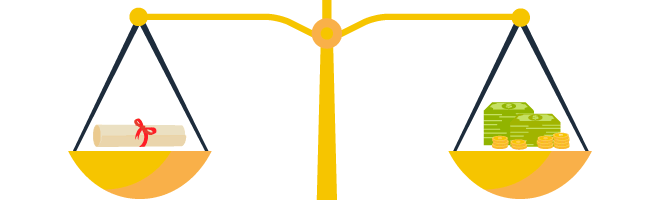
How much do you agree or disagree?

How much do you agree or disagree?
A) Strongly agree B) Agree C) Neutral D) Disagree E) Strongly disagree

I thought that maybe working right after graduation would be a good option, since I could make money right away and help my family. My Mentor showed me how to think about each of my options one at a time so I could make the best decision.
My real passion was (and still is!) music. I figured it would be great to make money doing what I love best.
Did that mean I should go to college? To university?
Or would I go straight to work and start making connections in the music industry?
I had SO MANY questions.
Would I end up getting a
good job with a decent salary?
How much would I even get in student aid, and would I have to pay it all back? What if I didn’t like the program? Wouldn’t it be a better idea to go
to work right away and save up for college?
I thought to myself “Is getting more education after high school really going to be worth it for me? I mean, am I really going to earn that much more money with a certificate, diploma, or degree?”
I asked some of my friends to share their reasons for getting
more education after high school. Watch the video!
If I did decide I wanted to get more education, I didn’t know how I would find the money to afford it. I was scared of taking on student loans – owing money was something I’d always been taught to avoid.

Did you know…?
GOOD debt vs BAD debt: Not many of us make enough money to pay cash for life’s biggest purchases,
like a home, a car, or higher education. Sometimes, that can mean borrowing money and taking on some debt.
But did you know that there is GOOD debt and BAD debt?
FastFact
Student loans are one of the cheapest forms of debt and only one of many sources of
financial aid to pay for education after high school.
Financial aid includes money you borrow that you have to pay back (like loans) and money
that’s given to you that you don’t pay back (like grants, bursaries, and scholarships).
Do you prefer to buy what you want right away or
save up for a bigger purchase in the future?
Join the 1,500 other people who took the Money Motto Style Survey and find out how your Money Motto Style influences your money-management habits and behavior!

Take the quiz here. After taking the quiz, tell us which was your Money Motto Style™

Don’t know if there’s a program out there that:
YOU WOULD LOVE?
YOU COULD AFFORD?
YOU COULD GET INTO?
Don’t worry. There are so many people and resources out there to help you figure out what you want to do after high school. Don’t be afraid to ask for advice, or to do some of your own research. That’s how I found out about an exciting college program in Music and Digital Media. And it was even close enough to home that I could commute!
Check out some Education Planning Tools here to get you started.
If you already know a program you want to study in after high school,
that’s great! But if you don’t know, that’s okay too.
You don’t need to know about any specific program of study for
School Cents: Part I because we’ll only be going over the general
pros and cons of higher education.
That’s when it hit me!
Figuring out the pros and cons – in other words, the costs and benefits – of any decision I have to make, like what to do after high school, is something I’ll need to do a lot in life.
It’s a skill I can learn.
Did you know…?
Any financial decision we make can have obvious costs – like the ticket price we pay for something.
But decisions also include other kinds of costs that are less obvious.

Did you know…?
Lesley Scorgie from The Money Project says this about the ‘hidden’ cost of higher education: “There’s the opportunity cost of hitting the books for a few years after high school: you forfeit income-earning opportunities because you’re not working full-time.” So while your friends are bringing home handsome pay cheques, you’re feeling a cash crunch because you’re paying for school.
What do YOU think?
HOW I DID IT

Step 2
I figured out what was important to me.
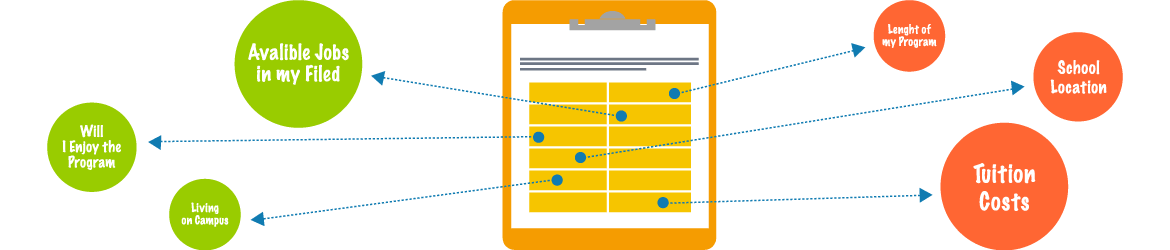
Whenever I have to make a big decision, I have to consider a lot of factors, like what’s important to me.
As you can see below, some factors are related to money or cost, others aren’t.

Step 3
I listed the possible options. I could:
Go straight to work
Go to higher education
Volunteer

Travel

Step 4
I evaluated each option based on what was important to me.
For now, we’ll look at one of the options:
getting more education after high school.

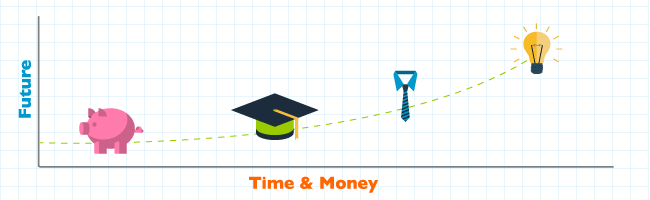
Making decisions isn’t easy! You need to know the pros and cons of your decisions, weigh all the options, and choose the best one for you.
Here’s how I weighed my pros and cons for getting more education after high school.
This method actually gave me a simple score to help me understand if my pros outweighed my cons or not. It also helped me separate the pros and cons related to financial costs versus other kinds of reasons (like meeting new people or learning new and exciting things).
It’ll be your turn to do this next so pay close attention. Click the arrows below to see how I did it.
These are your instructions.
Instruction 1:
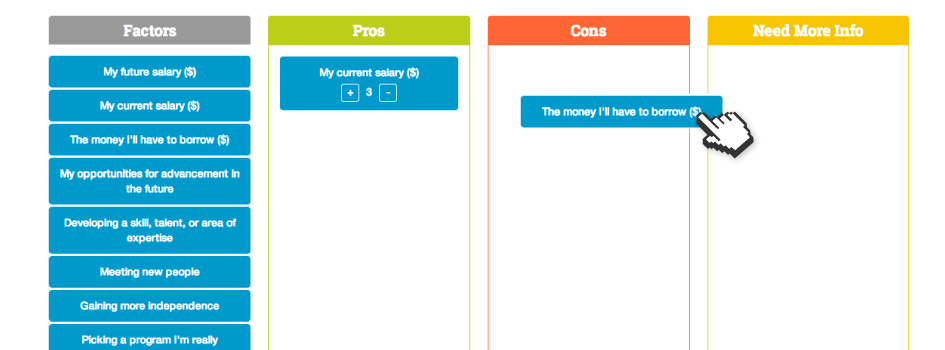
Look over the list of factors on the left of the table

Instruction 2:
When you see a factor that’s relevant to you, click and drag it to the PRO column, the CON column, or the NEED MORE INFO column. If the factor doesn’t apply to you, don’t use it.
Instruction 3:
How do you know if it’s a PRO or a CON? Ask yourself:
FOR ME, does this factor make me want to get more education after high school?
If you think YES → it’s a PRO
If you think NO → it’s a CON
If you think “I don’t know” OR “I’m not sure yet” → put it in NEED MORE INFO

Instruction 4:
Once all your factors have been placed in the columns you want, go over each one and assign a points value to each: 3 points = really important, 2 points = pretty important, 1 point = only a little important.

Instruction 5:
Once all your factors have been rated for importance,
click SAVE SCORE AND CONTINUE!

Instruction 6:
Now it’s your turn to go and do it!

My pros and cons of getting more education after high school
Complete the activity below to find out what your financial and overall scores are. Remember – you decide if it’s a pro or a con,
there are no right or wrong answers! Be brutally honest with yourself! Find out how we calculate your score.
I realized that most of my reasons for not getting more education after right after graduation had to do with money: I’d have to borrow money to go and I wouldn’t be making as much money as I could by working full-time.
But I also had a lot of good reasons for wanting to get more education in my list of pros.
Before I went further in making any sort of decision, I decided to put the reasons related to money in the “Need More Info” column. I didn’t actually know much school would cost me, so I didn’t know how much I might need to borrow, if anything. I also didn’t know about options that would allow me to earn money while I was in school, like co-op and summer jobs.
With my “Need More Info” list, I spent time looking up the information and asking for advice.
Step 5
Gather information and advice on the items on your “Need More Info” list and update your pros and cons list as you discover more information. Finding out new info can make all the difference in whether a factor is a pro or a con and how you score it.
If the cost of school or having to borrow money to go to school is one of your Cons or on your “Need More Info” list, School Cents: Part II will show you how to find out how much a program of your choice costs and how to pay for it.
Step 6
With my Financial Score and Overall Score results in hand, I realized that going to college was likely a good decision for me.
I was one BIG step closer to making the decision. What does your
result say about the option of pursuing higher education as a good decision for you?

Step 7

I did the same exercise for the other options – the higher the score, the more positives there are in favour of that option.
Here’s a link to a paper version of the Pros and Cons activity – you can go through it at many times as you need to, for as many decision options as you want!
Step 8
I reviewed my decision, and learned from it.

In the end, I decided I had absolutely nothing to lose – but everything to gain – by at least applying to college programs when the time came in Grade 12.
Where Am I Now?
After applying to four college programs, I was really surprised to have received an offer from two of them, even with the grades I had!
I could choose to attend a school close to home or one that meant I had to move away. I did the Pros and Cons activity again and, when I looked at my results, I decided to accept the offer from the school closer to home.


Even though I didn’t have any money saved up for college when I graduated high school, I still found a way to pay for it. It took a combination of student loans and grants, money I earned working hard each summer break, and whatever amount my parents could give me. I ended up owing only $2,340!
Well, the first year of college was hard but I was able to juggle the academic stuff with making new friends and keeping in touch with my friends from high school. When I would start to struggle in a class, I’d try my best to ask for help. I did that a lot, and I think it’s what got me through.
The program I started wasn’t quite what I thought it would be, so after I finished my first year, I switched my program. It was actually a lot easier than I thought it would be to do that, and I didn’t lose a lot of time.
Money was tight sometimes, for sure, but I would do my budget and spend the money I had wisely – learning how to manage my money was hard but it was worth it.


Yes! I ended up graduating with a 2 year diploma in Music Industry Arts. And I’m pretty proud of it. But I don’t want to take all the credit. I asked for and got a lot of help from my family, school friends, and my professors. I didn’t know there would be so many people willing to help.
It took me about a year to find a job in my field, so I worked at the family business while I looked for my first career job. I now work as a Junior Sound Engineer for a pretty cool company. I don’t make a ton of money yet but I have enough to live on my own, pay my bills, I got myself a used car, and I even have some money for fun. I’ll be done paying my student loans in a year or two – if I budget and manage my money right, I don’t find it hard at all to make my monthly loan payment.

My friends and mentors at the Club really believed in me and said I could do anything I put my mind to.
What do you think now?
Paying the costs of higher education is a good investment in my future.
How much do you agree or disagree?
I wouldn’t mind taking out a student loan because the higher earnings from higher education will enable me to pay back the loan fairly easily.
How much do you agree or disagree?
How much do you agree or disagree?
A) Strongly agree B) Agree C) Neutral D) Disagree E) Strongly disagree

How much do you agree or disagree? Tell us what you think:
A) Strongly agree B) Agree C) Disagree D) Strongly disagree
Congratulations, you have completed School Cents: Part I


Now you have a good idea of what you want to do next. So how will you pay for it? Continue on to Part II for lots of great information and ideas on that.
In Part II, you’ll meet Elly and she’ll show you how to estimate how much YOUR education after high school could cost you and, more important, she’ll show you how to find the money to pay for it!
Higher education probably doesn’t cost as much as you might think and there are a lot of different ways to cover the cost of going.