“I made the decision to keep studying after high school, but I needed a solid money plan to get me there.”
I needed to figure out how much it was
going to cost and how to pay for it.
Learn How
What will my education cost and where do I find the money?
I realized early on that it’s important to start thinking about how to pay for school. I’ll show you where you can find the money for school and I’ll also teach you how to build a budget so you can figure out how to pay for it!
What do you think about paying for higher education?
Let’s start with a few brief questions on your thoughts and opinions about paying for higher education.
Wondering why you’re being asked these questions? Click here.
Question 1 of 5
How much do you feel you know about each of the following options for funding higher education?
A) Know nothing or very littleB) Know relatively littleC) Have some knowledgeD) Know a fair amountE) Know a lot
Government student financial aid
Other scholarships or bursaries (e.g., from an institution or a private source)
Lines of credit or personal loans from a bank
Question 2 of 5
I know where to find the money to pay for higher education.
How much do you agree or disagree?
Question 3 of 5
How would you pay for your higher education?
If you were to get more education after high school, please tell us
which main sources of money you would likely use to pay for it:
A) YesB) NoC) I don’t know
Support from parents or relatives
Personal savings
Government student grants and/or loans
Scholarships or bursaries
Jobs (including part-time work, co-op or apprenticeship)
Line of credit or personal loan at a bank
Credit card
Other government assistance (e.g., employment insurance, First Nations funds, disability funds)
Question 4 of 5
I know how to make a budget that shows me how much I need to pay for higher education.
How much do you agree or disagree?
Question 5 of 5
I’ll be able to pay back any students loans needed to pay for higher education.
How much do you agree or disagree?
How can you find the money to pay for higher education?
Loans
A loan is money borrowed from a financial institution, like a bank. You can also apply for a student loan through provincial student assistance programs.
When you get a loan, you have to pay back the money borrowed (the principal) and the interest on the loan.
Grants
Grants are money awards you get based on high grades or financial need. You can also receive a grant when you carry out academic research projects.
Scholarships
A scholarship is a type of aid that you typically do not have to pay back.
Scholarships are money awards you get for your academic performance (high grades) or other achievements.
Bursaries
A bursary is a type of aid that you typically do not have to pay back. Bursaries are money awards you get based on your financial needs.
My Story
Hi! My name is Elly.
When I was in high school, I had a job working at a restaurant. I loved my job and I loved learning about food and nutrition, but wanted to learn more. I knew getting more education after high school would cost money. But how much really? I didn’t know.
I also didn’t know much about making a budget – in fact, I don’t think I knew what goes into a budget or even how much most things cost! I don’t remember anyone from my family openly talking about money, except saying they needed more of it!
We didn’t have a lot of money growing up, but it was still possible for me to go on in school! There are so many options out there and so many people want to help you pursue higher education.
I knew I wanted go to college after high school, so every week I saved some of my paycheque to help pay for tuition. But my guidance counselor reminded me that there are other costs too, like textbooks and transportation to get me to and from the school — there’s even a fee to apply to college! I told her that I didn’t think I’d have the money to cover all the costs.
So I started looking into government financial aid for higher education. Just like the students in this next video, I was surprised at just how much financial help I could get.
Financial aid for higher education: Stories from students
FastFact
If you put $20 in your bank account every week, you’ll have $1,040 by the end of the year, without interest. You’ll have even more if you put the money into an account that pays you interest.
If you’re a student from a low-income family, you will be eligible for grants (do not need to be repaid) from the Government of Canada, but ONLY if you also take out a loan.
HOW I DID IT
Step 1
I explored my program options
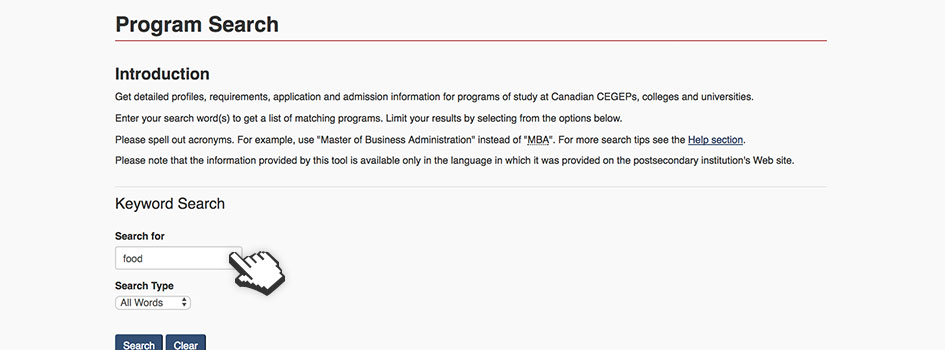
I knew I wanted to get more education after high school but I didn’t know exactly where or what I wanted to study. I knew that I enjoyed working at my job at the restaurant so I spent some time searching for programs in food and nutrition I thought I could really enjoy.
I used this Program Search tool to do this.
Here’s how I got started exploring my options (you’ll be following these steps too right after):
I used the filters to narrow down program options.
Slide 3 of 4
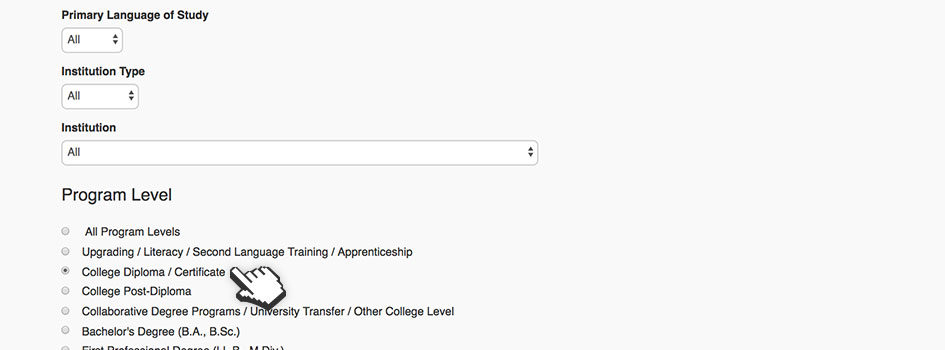
I didn’t know if I should explore programs at college or university, so I thought I would start
with college programs. So I selected “College Programs” in the dropdown Pathways menu.
If I didn’t find programs that interested me, I could easily explore university programs
by selecting University Programs in the menu instead.
Slide 4 of 4
I was pretty sure I wanted to stay at home, so I chose Alberta
as my province and searched for program names with “food”.
Step 2
I found at least one program that interested me
I clicked on the name of the program and got so much info about it.
Step 3
I found out how much tuition costs were
On top of looking at all the program requirements, I also found out a lot of important information about costs by looking at the Tuition Fee schedule in the Northern Alberta Institute of Technology website, since that is the school that I was interested in. Most post-secondary schools have information about program costs listed right on their website.
Not only was the cost of tuition easy to see but I also found
out how much I could expect to pay for housing and a bus pass!
Step 4
Then I came up with a sample budget
Using the info on costs I found in my research, I asked one of the staff from the Boys and Girls Club to sit down with me to help me with a budget.
Even if I didn’t know what all the exact costs would be or how much I would have in savings, I asked my mentor and we made our best guesses.
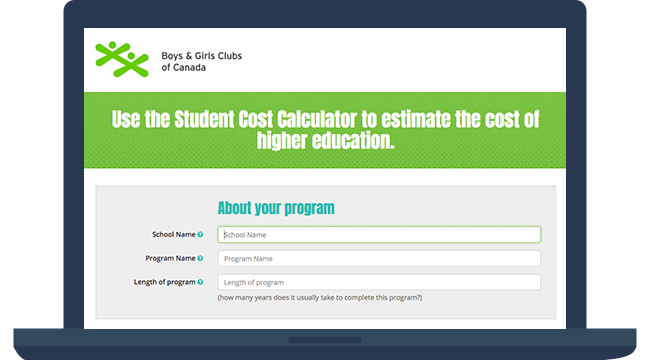
I used the program info I found on both the Program Search tool and
the school’s website to answer the questions on the form.
Slide 3 of 5
Look! The calculator does some of the estimating work for you. But you can
also change any of the amounts to make the budget more realistic for you.
Slide 4 of 5
Instruction 3:
Using the calculator, I did my best at estimating how much money I expected to have for my education.
Slide 5 of 5
Instruction 4:
Under the Student Cost Summary, I saw my costs compared with my funding, and most importantly, I found my
funding shortfall. That’s the amount I needed to find elsewhere to make it possible for me to pay
for my dream of going to college.
When I made a budget, I knew for the first time how much money I really needed to go to school.
Now it’s your turn to
build a budget for
YOUR higher
education
My Budget for Higher Education
Follow the same steps I did:
(if you need to, go back to the slideshow for more detailed instructions)
In ‘About your program’, enter your program info and click scroll down.
In ‘Calculate your school tuition cost’, enter the info as best as you can (guessing is ok) and keep scrolling.
In ‘How will you pay for school?’ input your budget (again, guessing is fine) and click ‘Calculate’.
Find your Student Cost Summary, and notice your shortfall.
Question 1 of 2
Tell Us:
What was your budget shortfall?
(e.g., 3200 / 3,200 / 3,200.00)
Question 2 of 2
Did you use the Student Cost Calculator to come up with this number?
Dealing with budget shortfalls
As a student, when you have a budget shortfall, you have two options. You can:
1. Find more money AND/OR
AND/OR
2. Reduce your expenses
Option 1: Find more money
Increase the money you have by earning more money through work or by getting financial aid.
Financial aid: finding the ‘free’ money
Scholarships, bursaries and grants – money to help pay for your studies that you don’t have to pay back!
Sure, some aid is based on grades, but many others are based on things like how involved you are in your community or in volunteering, where you live, on challenges you may have overcome, even what company or organization your parents work for. Some are based on financial need, others on academic merit, others on neither of these. You may also be surprised to learn that some awards – whether scholarships or bursaries – never get handed out because no one has applied to them!
Check out each of the links below to find out where you can find scholarships, bursaries and grants!
Canada Student Grants
Canada Student Grants provide money for college or university that you don’t need to pay back. It is easy to apply for them.
Canada Student Grants are available to students from most provinces and territories. In addition, some provinces and territories offer additional grants to students.
When you apply for student financial assistance, your eligibility for most Canada Student Grants and provincial/territorial grants will automatically be assessed when you apply for student loans. So, to find out how much you could be eligible for in grants and/or loans, go to the map of Canada in the next section and click on the province you live in.
Student
Awards
www.StudentAwards.com – an online database of government, institution, and private company scholarships. Membership is required (free).
Scholarships
Canada
www.ScholarshipsCanada.com – an online database of scholarships, bursaries and grants, with additional information about student loans, applications and budget planning.
Universities
Canada
www.univcan.ca – a list of scholarships and internships available to Canadian students and administered by Universities Canada.
National Educational Association
of Disabled Students
Post-Secondary Student Support Program (PSSSP) – Information on available financial support for eligible Status Indian or Inuit students who plan on doing post-secondary studies on a part-time or full-time basis and are registered with an eligible post-secondary institution.
Apprenticeship Grants
(Service Canada)
Apprenticeship Grants (Service Canada) – Information on how to apply for the Apprenticeship Incentive Grant and the Apprenticeship Completion Grant, designed to encourage more apprentices to undertake and complete their training.
Did you know…?
BGC Canada offers a number of scholarship programs.
Click here to find out more and ask your Club staff for information on how to apply.
Financial aid: finding money you will have to pay back
For many students, government student loans make all the difference between money saved for school and the cost of actually going to school.
The Government of Canada and most provincial or territorial governments work together to deliver federal and provincial student loan and grant programs to students who demonstrate financial need.
What does ‘financial need’ mean? The following equation and considerations are used to calculate how much funding you may be eligible to receive.
Allowable Educational Costs
Tuition fees
Books, supplies
Equipment
Computer costs
Local transporation costs
Personal living expenses
–
Expected Financial Contribution
Employment earnings
Scholarships
Savings
Family
RESP withdrawals
=
Calculated Financial Need
Student loans
Grants / bursaries
Wondering how much could you be eligible for in grants and loans?
Getting started is always tough! But finding out more about student loans doesn’t have to be. Every province and territory has helpful guides to get you started.
To start exploring student financial aid, click on your province or territory on the map below, or scroll over the name of your province or territory on the list.
True or false? You must be a full-time student in order to receive government loans and bursaries for higher education.
Did you know…?
Did you know that student loans are one of the cheapest forms of debt? Canada student loans have an interest rate of 5% while student credit cards from a bank have interest rates that start at almost 20% on anything you buy.
What is an interest rate?
How much does that loan REALLY cost you?
Elly has done a budget and figures she’ll need to borrow $5,000 to pay for her first year’s tuition at college. She wants to figure out which option is least expensive for borrowing the money she needs: a grant or bursary, a government student loan, a student line of credit from the bank, or a credit card. She knows she won’t be earning enough during her studies at college to pay off the loan, so she assumes that she’ll be paying all of it back (unless there are minimum payments she has to make every month) when she graduates after 2 years.
She wants to calculate how much each option REALLY costs if she needs to borrow $5,000, based on how quickly she thinks she can pay off the loan after she graduates from college.
(Click here if you’re curious about how these total amounts were calculated)
When do you have to repay a government student loan?
Did you know…?
Students from low-income families are eligible for grants from the Government of Canada
that don’t need to be repaid, even if they don’t take out a loan!
Option 2: Reduce your expenses
This option means making some tough choices.
There are some things that we NEED to have (like food, shelter, or clothing) and some things that we WANT to have (like an expensive phone or a new leather coat). When you have a budget shortfall, sometimes you have to look at what you need and make some tough choices by giving up things you want.
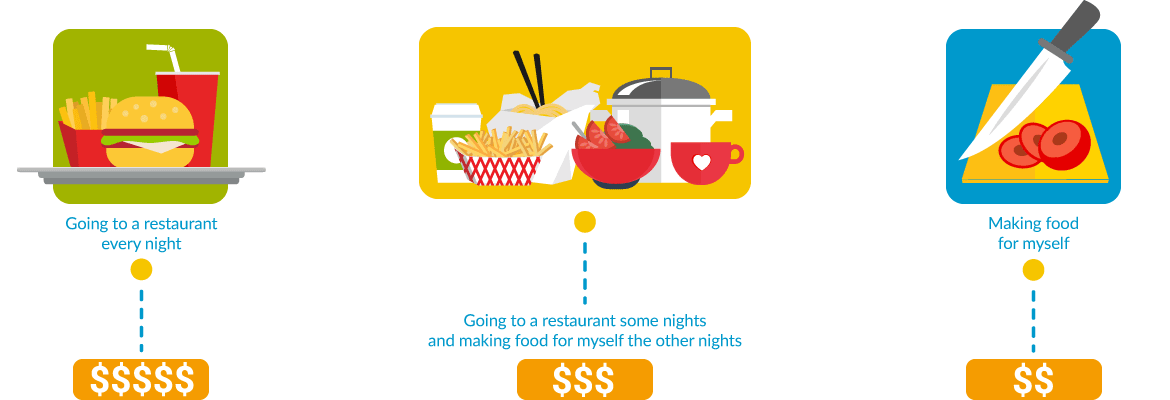
Let’s take a look at food. I love eating at restaurants, but eating out every night is expensive! I could save money by making food at home or cooking with my friends. Or, I could compromise: go out for supper once a week and make supper at home the other nights.
When I realized that I didn’t have enough money, I was pretty scared. I didn’t think I’d be able to keep studying after high school. But then I talked to the Boys and Girls Club leaders and with my guidance counselor. They recommended that I go back to my budget and see where I might be able to cut back on certain expenses.
By including your choice in your budget, you can make sure that you have enough money to spend on
the things you need (eating food) AND for the things you want (like eating at a restaurant).
Making a budget is just like any other skill: the more you do it, the better you’ll be at it.
Everyone’s budget is different. Yours might include different expenses or more sources of income than your friends’. You might need to budget your money for a whole year to pay back your loan or to make sure you have enough money to pay your tuition. Or you might just want to budget your money every month to make sure you have enough to pay your bills.
The best thing to do is to figure out your goals. What do you need money for? What do you have to pay? And remember: there’s no right or wrong way to make a budget, it just has to be right for you.
How a little can go a long way
Big expenses can seem like a lot of money, but if you plan ahead and save enough, you can cover the costs!
Save some money if at all possible – even a little each month. It can help you get into the habit of saving – and small amounts can add up! For example, putting a toonie a day in a jar will give you $730 by the end of the year!
If you’re an undergraduate student, government almost always take your parents’ income into consideration when figuring out if you need a loan.
Who can you ask for money advice?
“There are a lot of people who want to see you succeed! I didn’t know it at first, but when I started asking for advice about how to manage my money, I realized that everyone wanted to help me! Here are some of the places and people I went to see. Can you think of any others?
Boys and Girls
Club of Canada
The staff at the Boys and Girls Club are there to help! If you have questions about money or how to make a budget, they can help you get started.
High School
Guidance Counselor
You high school guidance counselor has helped a lot of students move on to higher education. They can help you figure out the costs and can help you figure out a plan to make sure you have enough to go.
Online
Resources
You can find a lot of financial resources online. We’ve identified a few in this module and you can easily find more by exploring online!
Financial Aid
Offices
Universities and colleges have financial aid offices and student groups who provide financial services. If you need help meeting your budget for the month, chances are, they know how to help!
Family
Your parents have to manage the expenses in your home and make sure that they stay within budget. They could offer you some important advice on how to make a budget and stick to it. If you have an older brother and sister who left home before you, they might be able to give you some good tips on how to budget your money!
Banks & Financial
Institutions
Financial experts in Canadian banks and other financial institutions can help you develop a financial plan, help you plan your finances, and give you some important money tips.
Where Am I Now?
Where did I go?
When the time came in Grade 12, I applied to four college programs in food and nutrition. I was nervous about applying but I knew I had done my research. Although I didn’t get accepted to all the programs, I did receive offers of admission from two of them. Both programs looked so interesting, so it was a really hard choice. I had to choose if I wanted to study in the program that was close to home or the one that was in another province.
I applied for government financial aid and guess what! The government was willing to help me through enough loans and grants that I could afford to study at either school — the choice was up to me. Although it’s more expensive to live away from home so it meant borrowing a greater amount, I decided I wanted to try living on campus. So that’s what I did!
How did I pay for it?
When I started college, I made a budget and I tried really hard to stick to it. It was tough! While I was in school, I always felt like I didn’t have enough money to buy the things I wanted. I really had to make some tough choices and cut back on some of the things I would usually buy. I had to spend the little money I had on the things I really needed. But making a budget helped me make sure that I had enough money left over at the end of the month to go see a movie with my friends, or buy a new pair of jeans.
After doing my budget, I knew I needed a loan to cover my shortfall. I applied for government student financial aid and got a student loan that was enough to cover most of my expenses. I also qualified for $250 a month for every month I was in school from the Canada Student Grant for Students from Low-Income Families – this was free money that I didn’t have to pay back. I also applied to scholarships and I got a few, including $1,000 from the Boys and Girls Club Post-Secondary Scholarships!
What didn't work out as planned?
Although I’m pretty happy with how I managed my money while I was in college, it took me a couple of semesters to figure out how to manage my money so that I had enough for the whole semester. A few times, I ran out of money because I spent too much on other things and I had to ask for a small emergency loan from the school (which I had to pay back of course).
I also had to find a part-time job on campus to help give me a little more room in my budget. I hadn’t planned on having to work 10 hours every week at a job while studying but the extra cash was great and I found a way to juggle my work shifts with my class schedule and homework.
Did I finish my program?
There were a few times during my studies when I seriously considered taking a break so that I could earn more money by working full-time. But then I’d talk it over with my school friends and many told me they often felt like they didn’t have enough money either. So we came up with some cool ideas to save money together, like weekly potluck dinners, having a ‘Budget Buddy’ so that each of us had one of our friends checking to make sure we were staying on track with our spending, and selling our textbooks back at the end of each semester.
In the end, I graduated from my Food and Nutrition program after 2 years, and even had enough money left over for a weekend trip to celebrate!
Where am I now?
With my college diploma in food and nutrition, I got a job as a Food Consultant at a mountain resort. I really like what I do – I play a lead role in coming up with the seasonal menus based on using local and organic products.
Today, I’m out of school but I still make budgets and I keep track of where I spend my money. It’s hard work and it isn’t always easy to get started, but I’m a lot better at managing my expenses and keeping my costs lower than my income.
Oh, and as for how I’m repaying the student loans I took to help pay for my program? I started my repayments six months after I graduated. I’m paying back about $325 every month and I should be done paying off my loans in 2-3 years. For me, it was really worth it!
My budget helps me make better decisions about where to spend my money and how I can afford the things I want.
What do you think about paying for higher education now?
Question 1 of 6
How much do you feel you know about each of the following options for funding higher education?
A) Know nothing or very littleB) Know relatively littleC) Have some knowledgeD) Know a fair amountE) Know a lot
A) Government student financial aid
B) Other scholarships or bursaries (e.g., from an institution or a private source)
C) Lines of credit or personal loans from a bank
Question 2 of 6
I know where to find the money to pay for higher education.
How much do you agree or disagree?
Question 3 of 6
I feel confident in my ability to apply for government student financial aid to help me pay for higher education.
How much do you agree or disagree?
Question 4 of 6
I’ll be able to pay back any students loans needed to pay for higher education.
How much do you agree or disagree?
Question 5 of 6
I know how to make a budget that shows me how much I need to pay for higher education.
How much do you agree or disagree?
Question 6 of 6
How much do you agree or disagree? Tell us what you think:
A) Strongly agreeB) AgreeC) DisagreeD) Strongly disagree
This module was clear and easy to understand
The information in this module was new to me
This module has changed the way I think about paying for higher education
Congratulations, you have completed School Cents: Part II
Congratulations on completing the School Cents badge! We hope Cam and Elly shared enough of their story and their tips and advice to make your decision
about pursuing and paying for education after high school a little easier.
The question now remains: what will you want your story to be?
×
School Cents: Part II is brand new and we want to know if it helps young people make decisions about investing in higher education. We also want to know if you like the module or not so we can make it better in the future. We ask everyone the same questions. There are no right or wrong answers, so just be yourself and answer the questions as honestly as you can.
No one at your Club will have access to your answers. Your answers will only be used to test out the module (not you).
If you or your parents have questions about this module, or if you don’t want to answer the questions but still want to do the module, contact Vivian Trumblay at BGC Canada: 905.477.7272 extension 227, vtrumblay@bgccan.com
×
If you’re not sure what interest is, don’t worry. I’ll explain what it is a little later on.
Actually, this is false. Students from low-income families are eligible for grants even if they don’t take out a loan.
But don’t forget: you sometimes have to apply for student loans in order to get grants. So if you’re offered a loan and a grant from the government, you can turn down the loan and accept only the grant.
Correct! Students from low-income families are eligible for grants even if they don’t take out a loan.
But don’t forget: you sometimes have to apply for student loans in order to get grants. So if you’re offered a loan and a grant from the government, you can turn down the loan and accept only the grant.
This is false. Government loans and bursaries are given out based on financial need. If you qualify, you can receive loans and grants from the government even as a part-time student!
Correct! Government loans and bursaries are given out based on financial need. If you qualify, you can receive loans and grants from the government even as a part-time student!
Actually, an interest rate is how much you have to pay someone to borrow their money. Or, how much you get paid for lending out your money to someone else. Think about it: when you borrow someone else’s money, they can’t use that money to pay for things. So, to compensate, you pay them a small fee. That fee is called the interest rate.
Yes! But… it’s also how much you get paid for lending your money to someone else.
Actually, an interest rate is how much you have to pay someone to borrow their money or how much you get paid for lending out your money to someone else.Think about it: when you borrow someone else’s money, they can’t use that money to pay for things. So, to compensate, you pay them a small fee. That fee is called the interest rate.
Yes! But… it’s also how much you have to pay to borrow someone else’s money.
Correct! An interest rate is how much you have to pay someone to borrow their money or how much you get paid for lending out your money to someone else.
×
The goal of this slider is to show the difference in the actual cost of borrowing from each of the four sources when payments (during and after studies) and time taken to pay off the loan are taken into account.
All four options are based on the same basic premise: Elly starts her 2 year college program on Day 1 with $5,000 in borrowed money. She will carry this debt for the duration of her studies and she thinks with part-time jobs and summer work she can finish her program without borrowing more than the $5,000 — she doesn’t think she’ll need to borrow any additional money for her studies. She assumes she won’t be making enough money during her studies to pay anything more than the minimum monthly payment, if the lender requires this. She plans on starting her repayment period right after she graduates, even though she knows that student loans from the government and student lines of credit with the banks often have grace periods that give students between 6-12 months after graduation before they have to start repayments.
For the government student loan option, Elly’s calculation is based on a fixed interest rate of prime (3%) + 5%, as per Canada Student Loans Program Loan Repayment Estimator. The government would not be charging interest on Elly’s student loans while she’s in school, which means when Elly graduates from her program in two years, she’ll owe the same amount: $5,000.
For the student line of credit option, Elly’s calculation is based on a fixed interest rate of prime (3%) + 1%. Unlike government student loans, the bank will charge Elly interest on her loan while she’s in school, and she’ll need to pay this interest charge every month. With a loan of $5,000, the monthly interest charge is $17. Since she’ll be paying the interest during her studies, she’ll owe only the original $5,000 when she graduates from her program in two years.
For the credit card option, Elly’s calculation is based on interest rate of 18% and a monthly minimum payment of 3% of the balance. This monthly minimum payment is important: it means Elly will pay an average of $126.76 every month during her studies. However, unlike the government student loan and line of credit options, Elly’s minimum monthly payments on the credit card will pay off some of the loan during her studies, so by the time her repayments begin after she graduates, her remaining balance will be $3,479.
×
Elly will need pay the interest on the loan every month while she’s in school: that’s $17 per month for two years (this amount is included in her calculation). In order to get the loan, she’ll also likely need a prior credit history or co-signor.
A credit history is a collective report about how you’ve historically managed your debt and begins the very first time you get a credit card in your name, a loan or line of credit from a bank
For most students like Elly who don’t have an established credit history, it means she’ll have to find a co-signor for the loan. A co-signor is usually a parent or other family member/friend who promises to pay off the loan in the event the primary borrower (Elly) is unable to pay off the loan. To be eligible to co-sign, a co-signor has to have a good credit rating. A credit rating is a measure of how dependable you are when it comes to repaying your debts.
×
A major bonus with government loans: interest won’t accumulate on the amount borrowed until Elly graduates from college. Plus, no prior credit history or co-signor is required.
A credit history is a collective report about how you’ve historically managed your debt and begins the very first time you get a credit card in your name, a loan or line of credit from a bank
For most students like Elly who don’t have an established credit history, it means she’ll have to find a co-signor for the loan. A co-signor is usually a parent or other family member/friend who promises to pay off the loan in the event the primary borrower (Elly) is unable to pay off the loan. To be eligible to co-sign, a co-signor has to have a good credit rating. A credit rating is a measure of how dependable you are when it comes to repaying your debts.
×
Elly will need to pay a minimum monthly payment every month while she’s in school. The amount of this minimum payment varies across credit cards but Elly assumes a rate of 3% of the balance: that’s an average of $126.76 per month for two years (this amount is included in her calculation). She’ll also likely need a prior credit history or co-signor.
A credit history is a collective report about how you’ve historically managed your debt and begins the very first time you get a credit card in your name, a loan or line of credit from a bank
For most students like Elly who don’t have an established credit history, it means she’ll have to find a co-signor for the loan. A co-signor is usually a parent or other family member/friend who promises to pay off the loan in the event the primary borrower (Elly) is unable to pay off the loan. To be eligible to co-sign, a co-signor has to have a good credit rating. A credit rating is a measure of how dependable you are when it comes to repaying your debts.
Actually, you usually don’t have to start paying back your government student loan until 6 months after you graduate. This gives you some time to find a job and start saving some money before you have to repay your government student loan. The government also has a Repayment Assistance Plan to make sure that you pay back what you can afford.
Actually, you usually don’t have to start paying back your government student loan until 6 months after you graduate. This gives you some time to find a job and start saving some money before you have to repay your government student loan. The government also has a Repayment Assistance Plan to make sure that you pay back what you can afford.
Yes! You usually have 6 months after you graduate to find a job and start saving some money before you have to repay your government student loan. The government also has a Repayment Assistance Plan to make sure that you pay back what you can afford.
A loan is different from a scholarship or bursary: you do need to pay back a loan. However, you usually don’t have to start paying back your government student loan until 6 months after you graduate. This gives you some time to find a job and start saving some money before you have to repay your government student loan. The government also has a Repayment Assistance Plan to make sure that you pay back what you can afford.
Correct! Unless you are a Crown Ward, an older student, or qualify as an independent student, the government considers your family’s income to determine if you are eligible for a government funded student loan.
If your parents have an income under a certain amount, the government assumes that they can’t contribute financially to your education and will provide you with grants or higher loans. People who are married, are single parents, have been employed in the last 24 months, or left high school more than four years ago, are considered financially independent.
Actually, this is true. Unless you are a Crown Ward, an older student, or qualify as an independent student, the government considers your family’s income to determine if you are eligible for a government funded student loan.
If your parents have an income under a certain amount, the government assumes that they can’t contribute financially to your education and will provide you with grants or higher loans. People who are married, are single parents, have been employed in the last 24 months, or left high school more than four years ago, are considered financially independent.













 I opened the
 I used the filters to narrow down program options.
 I didn’t know if I should explore programs at college or university, so I thought I would start
with college programs. So I selected “College Programs” in the dropdown Pathways menu.
If I didn’t find programs that interested me, I could easily explore university programs
by selecting University Programs in the menu instead.
 I was pretty sure I wanted to stay at home, so I chose Alberta
as my province and searched for program names with “food”.
 I clicked on the name of the program and got so much info about it.
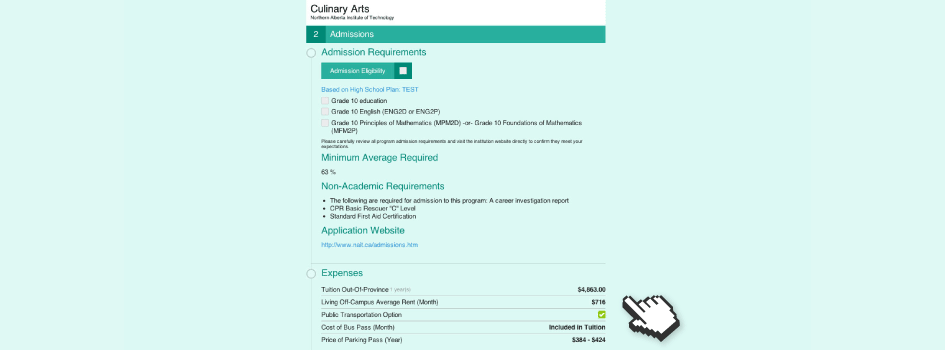 Not only was the cost of tuition easy to see but I also found
out how much I could expect to pay for housing and a bus pass!
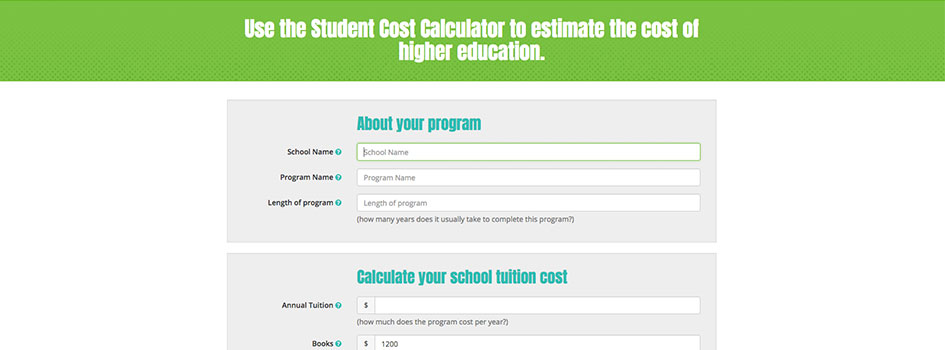

 Look! The calculator does some of the estimating work for you. But you can
also change any of the amounts to make the budget more realistic for you.